



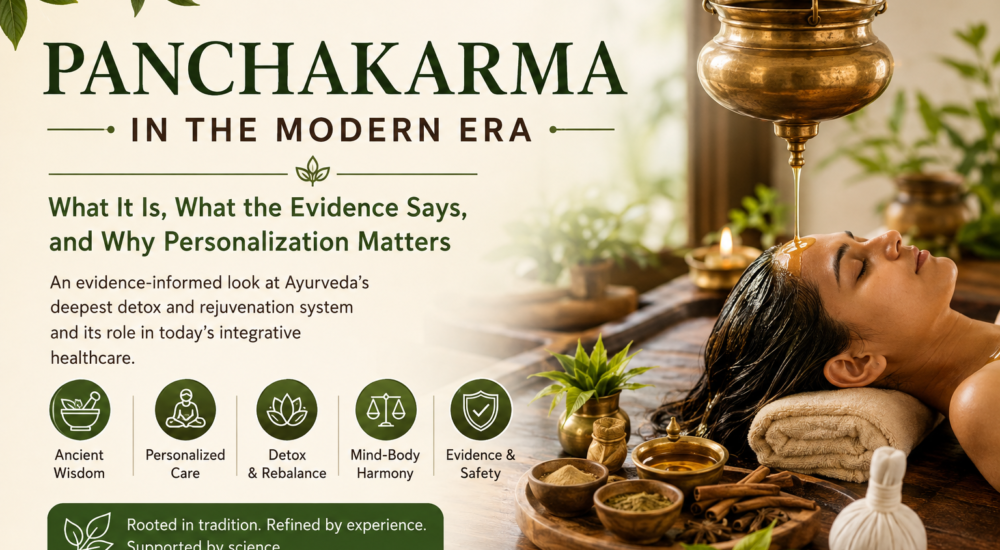
Panchakarma is one of the most recognized therapeutic approaches within Ayurveda. Around the world, people increasingly seek Panchakarma programs for concerns ranging from digestive health and stress to musculoskeletal problems, metabolic disorders, and general wellness.
At the same time, Panchakarma is frequently presented online as a simple “detox,” a wellness cleanse, or a universal treatment package.
This oversimplification misses the fundamental Ayurvedic concept behind Panchakarma.
Traditionally, Panchakarma is a system of therapeutic procedures that are selected according to the individual’s condition, strength, Dosha involvement, digestive capacity, disease stage, and treatment objectives. It is not simply a five-day or seven-day cleansing program that should be identical for everyone.
Contemporary research is beginning to examine Ayurvedic interventions, including Panchakarma, in clinical settings. However, the evidence remains heterogeneous, and researchers continue to identify the need for better standardization, larger clinical trials, and longer-term safety data.
This makes an evidence-informed and clinically responsible approach particularly important.
What Is Panchakarma?
The Sanskrit term Panchakarma literally refers to “five actions.”
In the classical Ayurvedic framework, the five principal therapeutic procedures are traditionally described as:
- Vamana – therapeutic emesis
- Virechana – therapeutic purgation
- Basti – medicated enema therapy
- Nasya – administration of medication through the nasal route
- Raktamokshana – therapeutic bloodletting
The exact interpretation and clinical application of these procedures can vary across Ayurvedic traditions and clinical settings.
Importantly, Panchakarma is not limited to the principal procedures themselves.
Ayurvedic clinical practice traditionally emphasizes Purvakarma, or preparatory measures, followed by the selected principal procedure and then Paschatkarma, or post-procedure care.
Therefore, a Panchakarma program is better understood as a therapeutic process, rather than a single intervention.
Why Is Panchakarma Different From a Modern “Detox”?
The word “detox” has become extremely popular in modern wellness marketing.
However, the Ayurvedic concept of Panchakarma should not automatically be equated with the biomedical concept of removing unspecified “toxins” from the body.
Ayurveda has its own conceptual framework involving Dosha, Agni, Ama, Dhatu, and Srotas.
From an Ayurvedic perspective, clinical assessment determines whether these factors are relevant to a particular individual and whether Shodhana therapy is appropriate.
From a biomedical perspective, the body already possesses highly developed systems for metabolism and elimination, particularly through the liver, kidneys, gastrointestinal tract, lungs, and skin.
Consequently, responsible communication about Panchakarma should avoid claiming that every person needs “detoxification” or that Panchakarma universally removes accumulated toxins.
Instead, it is more appropriate to describe Panchakarma according to its traditional therapeutic rationale and the specific clinical evidence available for the intervention being studied.
The Importance of Purvakarma
One of the most important concepts that can be lost in modern Panchakarma packages is preparation.
Traditionally, preparatory measures may include procedures such as:
- Deepana – supporting digestive capacity
- Pachana – addressing impaired digestion according to the Ayurvedic clinical assessment
- Snehana – internal or external oleation where appropriate
- Swedana – therapeutic sudation where indicated
These are not simply spa treatments.
Their selection, duration, intensity, and sequence should be based on the individual.
For example, a person with significant weakness may require a very different therapeutic strategy from a strong individual undergoing a planned Shodhana procedure.
This is why the principle of Rogi Bala—the strength and capacity of the patient—is clinically important.
Panchakarma Should Be Individualized
There is no universally appropriate Panchakarma protocol.
Two people with the same diagnosis may have different:
- Prakriti
- Vikriti
- Dosha predominance
- Agni status
- Age
- Physical strength
- Digestive tolerance
- Medication use
- Comorbidities
- Disease stage
- Mental and emotional status
Therefore, the Ayurvedic physician’s role is not simply to select a treatment from a menu.
The clinician must determine:
Is Shodhana indicated?
Which procedure is appropriate?
When should it be performed?
What preparation is required?
What dose or intensity is appropriate?
How should the patient be monitored?
What should be done after the procedure?
These questions are central to safe Panchakarma practice.
What Does Current Research Tell Us?
The scientific evidence surrounding Ayurveda is growing, but it should be interpreted carefully.
A 2026 review of clinical evidence in chronic disease management reported promising trends for several Ayurvedic interventions, including improvements in symptoms, functional outcomes, inflammatory markers, and quality of life in selected clinical settings. However, the authors also highlighted substantial limitations, including heterogeneous interventions, small sample sizes, methodological variation, and limited long-term safety information.
A separate 2026 review examining Ayurveda in contemporary healthcare similarly found that Panchakarma and other Ayurvedic interventions have been associated with changes in metabolic, inflammatory, autonomic, gastrointestinal, and other physiological outcomes in specific studies, while emphasizing that the evidence is context-dependent and not uniformly generalizable.
This distinction is important.
A positive result from one clinical study does not mean that every Panchakarma procedure is effective for every disease.
Evidence needs to be evaluated according to:
- The specific procedure used
- The condition being treated
- The patient population
- The comparator
- Treatment duration
- Outcome measures
- Study quality
- Safety reporting
Why Standardization Matters
One of the major challenges in researching Ayurveda is that Ayurvedic treatment is often individualized.
That is clinically meaningful but scientifically challenging.
Two patients may receive different treatments for what conventional medicine calls the same disease because their Ayurvedic assessments differ.
Researchers have noted that individualized and complex Ayurvedic interventions create challenges for conventional randomized controlled trial designs.
This does not mean that Ayurveda cannot be scientifically studied.
Rather, it means that research methodologies need to carefully capture both:
standardization where appropriate
and
individualization where clinically necessary.
Recent work on clinical consensus statements for Ayurvedic procedures, including Nasya, illustrates the movement toward clearer procedural standards, quality assurance, preparation, dosage considerations, and post-treatment care.
This is an important development for the future of integrative Ayurveda.
Panchakarma and Chronic Disease: An Integrative Perspective
Panchakarma should not be presented as a replacement for necessary conventional medical treatment.
Instead, in appropriate cases, Ayurvedic interventions may be considered as part of a broader integrative strategy.
For example, a patient with a chronic condition may require:
- Conventional diagnosis
- Appropriate pharmacological treatment
- Nutrition intervention
- Physical activity
- Sleep optimization
- Stress management
- Ayurvedic lifestyle intervention
- Selected Ayurvedic therapies
- Ongoing monitoring
This approach respects the strengths of different healthcare systems.
The concept of integrative medicine is fundamentally different from replacing conventional medicine with an unproven alternative. Complementary approaches are used alongside conventional care, with attention to evidence and safety.
Safety Should Always Come First
“Natural” does not automatically mean “safe.”
This is particularly important when Ayurvedic medicines are used alongside Panchakarma.
The National Center for Complementary and Integrative Health notes that some Ayurvedic preparations may contain lead, mercury, or arsenic in potentially toxic amounts. It also highlights the possibility of interactions between herbal products and conventional medicines.
Therefore, patients should inform their healthcare professionals about all medications, supplements, and Ayurvedic preparations they are taking.
A responsible Panchakarma program should include appropriate assessment and consideration of:
- Current medications
- Pregnancy status where relevant
- Age
- Hydration
- Nutritional status
- Cardiovascular status
- Renal and hepatic function where clinically relevant
- Existing chronic diseases
- Previous treatment history
- Contraindications to specific procedures
More intensive procedures should never be approached as casual wellness activities.
Who Should Avoid Self-Directed Panchakarma?
Self-administering therapeutic Panchakarma procedures based on social-media instructions can be unsafe.
Procedures involving therapeutic emesis, purgation, enemas, or other intensive interventions require appropriate clinical judgment.
People with significant medical conditions, those taking multiple medications, pregnant individuals, older adults with frailty, and people with substantial nutritional or physical weakness may require particular caution.
The appropriate question is not:
“Which Panchakarma treatment is best?”
It is:
“Is Panchakarma appropriate for this individual, and if so, which intervention, sequence, intensity, and duration are appropriate?”
That distinction can prevent unnecessary complications.
What Happens After Panchakarma?
Post-treatment care is another important component.
Ayurveda traditionally describes Samsarjana Krama, a graduated dietary approach following certain intensive purification procedures.
The underlying principle is straightforward: after a significant therapeutic intervention, the transition back to a normal diet should be appropriately managed rather than immediately returning to heavy meals and an irregular lifestyle.
Post-treatment planning may also involve:
- Rest
- Appropriate diet
- Gradual return to normal activity
- Sleep regulation
- Lifestyle modification
- Follow-up assessment
In other words, Panchakarma should not be viewed as something that ends when the procedure ends.
The period afterward can be an important opportunity to establish sustainable health behaviors.
Five Practical Lessons for Anyone Considering Panchakarma
1. Don’t choose a package before receiving an assessment
A standardized “7-day Panchakarma package” may not be appropriate for every individual.
2. Ask what the treatment is intended to accomplish
A responsible practitioner should be able to explain the therapeutic objective in understandable terms.
3. Tell your practitioner about your medications
Herbal products and other complementary interventions can interact with conventional medicines.
4. Don’t stop essential medical treatment
Panchakarma should not be used as a reason to postpone diagnosis or discontinue medically necessary treatment.
5. Look for quality and clinical supervision
The practitioner should use appropriate assessment, informed consent, procedural standards, monitoring, and follow-up.
The Future of Panchakarma
The future of Panchakarma does not have to be a choice between tradition and modern science.
A stronger future lies in bringing the two into constructive dialogue.
Classical Ayurvedic knowledge provides a sophisticated framework for individualized assessment and therapeutic decision-making.
Modern research provides tools for evaluating effectiveness, mechanisms, safety, quality control, and clinical outcomes.
The challenge is to bring these approaches together without oversimplifying either one.
Future research should prioritize:
- Well-designed clinical trials
- Larger sample sizes
- Standardized reporting
- Patient-centered outcomes
- Long-term follow-up
- Safety monitoring
- Reproducible protocols
- Appropriate biomarkers
- Comparative-effectiveness research
- Clear definitions of Panchakarma procedures
This would help clinicians, researchers, patients, and policymakers better understand where Panchakarma is useful, for whom, and under what circumstances.
Practical Takeaways
If you are considering Panchakarma, remember these five principles:
Assess first.
Individualize the treatment.
Prioritize safety.
Use evidence responsibly.
Integrate rather than unnecessarily replace conventional care.
Panchakarma is more than a wellness package. In its traditional therapeutic context, it is a structured clinical intervention that requires appropriate selection, preparation, execution, and follow-up.
Panchakarma has an important place in the Ayurvedic therapeutic tradition and continues to attract interest in contemporary integrative healthcare.
The opportunity today is not to make exaggerated claims about Panchakarma.
The opportunity is to study it carefully, practice it responsibly, preserve its classical clinical logic, and integrate useful elements with modern standards of safety and evidence.
Ayurveda does not become stronger by making claims that science cannot support.
It becomes stronger when traditional knowledge, clinical expertise, patient-centered care, and rigorous research work together.
If you are considering Panchakarma, seek an individualized assessment from a qualified Ayurvedic professional rather than selecting a procedure solely because it is popular online.
Ready to Explore Ayurveda More Deeply?
Learn about Ayurvedic principles, Panchakarma, lifestyle medicine, and integrative approaches through structured clinical education and supervised practical training.
Start your journey with evidence-informed Ayurveda and individualized care.
Medical Disclaimer
This article is for educational purposes only and does not constitute medical advice, diagnosis, or treatment. Panchakarma procedures should be selected and performed by appropriately qualified professionals after individual assessment. People with medical conditions or those taking prescription medicines should discuss complementary therapies with their healthcare providers.